May 27, 2026
I Twisted My Knee Skiing and Built MRI Scout
In April I twisted my knee skiing.
Nothing heroic. No helicopter, no dramatic mountain story. Just one bad movement, a strange feeling in the knee, and the usual human optimism: maybe it is fine.
It was not fine.
So I went through the normal process. Doctor, MRI, waiting. The MRI itself is quick. The funny part is that the scan is done immediately, but the result still takes days.
And days are plenty of time to sit at home and overthink everything.
The other funny part: they still give you the MRI data on a CD. A CD. In 2026.
I did not even have a CD drive anymore, because apparently I believed we had moved past that stage of civilization. One external drive order fixed that in a few hours.
The waiting was harder to fix. So I built a small app: MRI Scout.
The idea
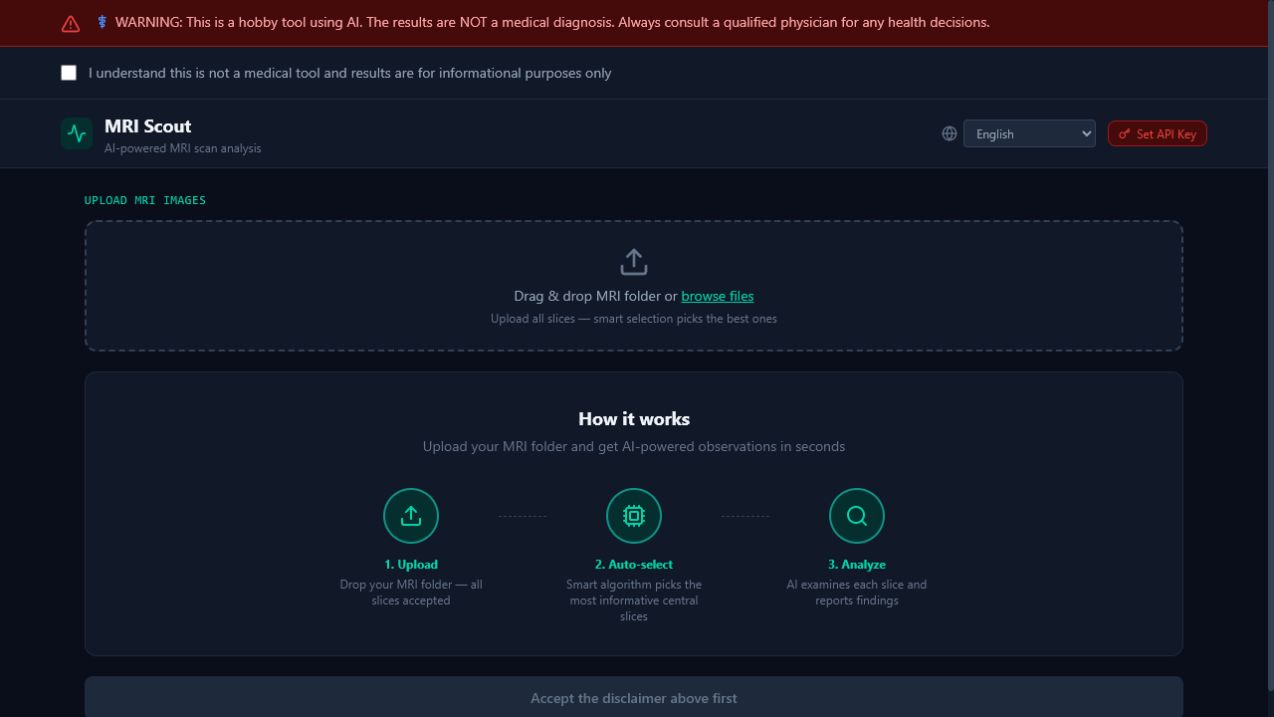
The idea is simple. If you take the MRI images with you after the scan, the app can load them, pick the useful slices, and send them to an AI model for a quick orientation.
Not a diagnosis. Not a replacement for a doctor. Just a fast first look, so you are not staring at a plastic disc for several days wondering what is inside.
For my scan, MRI Scout processed 232 JPG files from the MRI export. It selected 50 representative slices and sent them through OpenAI gpt-4o. The result came back in about 90 seconds.
And it was useful.
The result
It flagged significant cruciate ligament damage, possibly even a complete rupture. It also pointed to related findings around the knee, like bone marrow signal and soft tissue edema.
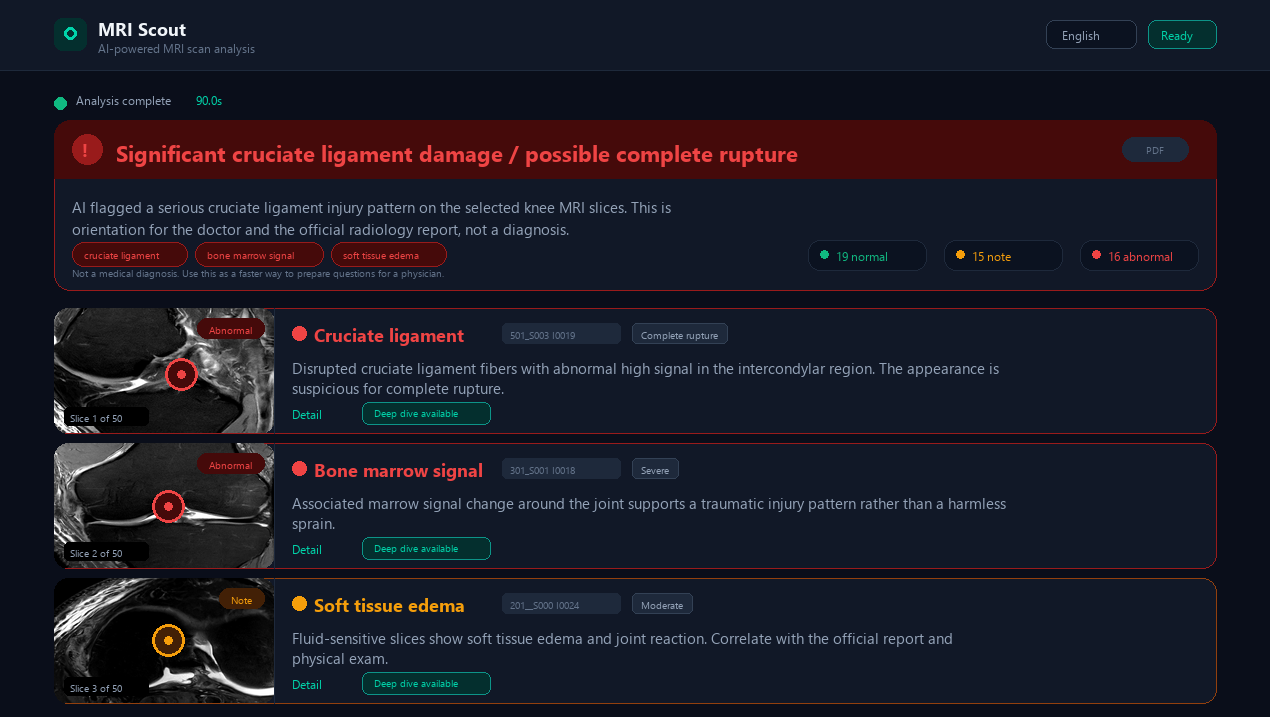
Again, this is not where you decide treatment. That still belongs to the official report and a real doctor. But it is enough to know that this is probably not "just walk it off".
Three days later, the official result came back. MRI Scout was very close to what the report said. Not perfect, not something I would use instead of a doctor, but close enough to prove the point: waiting completely blind does not make much sense anymore.
That is the whole point.
Free if useful
MRI Scout is not trying to be your doctor. It does not wear a white coat, it does not have a waiting room, and it definitely should not decide what happens to your knee. It is just a small tool for the annoying gap between the scan and the result. The scan exists. The data exists. The AI can look at images. But the patient still waits.
If someone wants it, MRI Scout is free under the MIT license.
I do not plan to maintain it like a real product. Honestly, I hope I will not need it again. :) But if someone else does, they do not have to start from zero. Most likely, upgrading the model and maybe refreshing the UI will be enough to keep it useful even a year from now.
KORD: what changed after your feedback
September 8, 2026
Larger draft previews, simpler agent connections and a clearer view of what's scheduled and what actually went live.
Give Your AI Agent Somewhere to Work
August 30, 2026
KORD gives AI agents a controlled way to prepare, schedule and publish posts to your business social accounts.
Turn team and AI agent work into clear client reports
August 21, 2026
Every month I was rebuilding client work from email, timers and agent threads. FoxDesk Cloud keeps the request, recorded work and client report together without asking you to run a server.
Terminal: The Most Efficient Way to Work With AI Agents. A Complete Guide From Zero.
March 29, 2026
The most efficient way to use AI agents starts in the terminal. A complete setup guide covering Git, sessions, project files, and the workflow that actually works. From absolute zero.
I Built an App with AI: Here's What Nobody Tells You
March 12, 2026
A month-long journey of building a real app with AI. No fairy tales, no doom, just practical lessons about taste, judgment, and leverage that nobody talks about.
FoxDesk v0.3.75 Is Live
March 6, 2026
FoxDesk v0.3.75 marked the first public open-source release. The AGPL-3.0 edition remains public at foxdesk.net, while the separately operated FoxDesk Cloud service is now available in public beta.
The People Who Show Up Early Rarely Stay on the Sidelines
February 27, 2026
The mood around AI right now is strange, and honestly a little funny. Not long ago, it was mostly novelty, but now every conversation swings between extreme optimism and panic. This essay explains why the real advantage still belongs to people who start building before everyone else agrees.